






















The Shopify ecosystem in 2026 is no longer just growing, it is maturing into one of the most influential layers in global commerce. For merchants, agencies, and investors, the real question is no longer whether Shopify matters, but which app companies are best positioned to shape the next phase of growth across SEO, retention, customer trust, international expansion, and AI-assisted commerce.
Here are the most important industry insights defining the Shopify app market in 2026:
- Shopify reported $11.56 billion in FY2025 revenue, confirming its transition from a high-growth platform into a large-scale commerce infrastructure company.
- The platform processed $378.44 billion in GMV, showing how deeply Shopify is embedded in global digital retail.
- Shopify now supports around 5.6 million live stores globally, with a broader footprint exceeding 9.6 million web presences when related storefront surfaces are included.
- The Shopify App Store has expanded to 17,356+ apps, making merchant app selection more strategic than ever as competition intensifies.
- The “Built for Shopify” badge has become a major trust and performance signal, with 1,290 apps reaching that standard by March 2026.
- Shopify’s higher-value segments are accelerating fast: B2B GMV grew 96% year over year, while 47,000+ live sites now run on Shopify Plus.
- AI is already reshaping commerce discovery, with orders originating from AI search platforms increasing 15x since early 2025, while headless storefronts continue to outperform traditional architectures on speed and performance.
Against that backdrop, the most important Shopify app companies are not just building useful features. They are building the infrastructure that helps merchants rank better, convert faster, retain customers longer, scale internationally, and operate more efficiently in an increasingly competitive platform economy. That is the lens this analysis uses to evaluate the top Shopify app companies in 2026.
TL;DR
Too Long; Didn’t Read? Here’s what you need to know:
| If You’re Looking For | Best Company | Why They Stand Out |
| Multi-app Shopify growth ecosystem | Storeware | Portfolio across SEO, reviews, FAQs, docs, options, and AI video |
| High-converting landing pages | PageFly | Mature page-building leader with massive merchant adoption |
| Better post-purchase tracking | TrackingMore | Shipment visibility, branded tracking and lower support friction |
| Reviews + loyalty in one place | Rivyo | Cost-efficient trust and retention stack |
| Affiliate and referral growth | UpPromote | One of the most established affiliate-growth tools in Shopify |
| Upsells and AOV growth | FoxEcom / FoxKit | Practical merchandising and offer optimization toolkit |
| All-in-one retention layer | AiTrillion | Loyalty, reviews, email, SMS, push, and automation |
| Privacy compliance | Consentik | Merchant-friendly GDPR/CCPA infrastructure |
| Social proof popups and urgency | ToastiBar | Fast tactical conversion wins |
| Global selling via language and currency | Transtore | Localization and SEO-aware internationalization |
| Product reviews and trust-building at scale | Judge.me | Massive Shopify footprint, strong review ecosystem, flat pricing, and deep social-proof functionality |
| Third-party review reputation management | Reputon | Broad portfolio for Google, Trustpilot, Facebook, Etsy, Amazon, and testimonial-based reputation building |
Market Overview of the Shopify Ecosystem 2026
Shopify is no longer simply a platform for launching online stores. It is one of the dominant software infrastructures of global commerce. According to the report, Shopify crossed $11.56 billion in annual revenue in FY2025, recorded $378.44 billion in GMV, generated $2.0 billion in free cash flow, and sustained a long run of 25%+ quarterly revenue growth.
Analysts projected Shopify’s FY2026 revenue to approach $14.94 billion, which reinforces the view that the platform is now operating at a durable scale rather than startup-era hypervolatility.
A few ecosystem data points help explain why app companies matter so much within that scale. Shopify supports about 5.6 million live stores globally, with a broader digital footprint of over 9.6 million when subdomains and related surfaces are counted.
It commands roughly 30% of the U.S. eCommerce platform market, outperforming many direct rivals, and approximately 875 million unique buyers interacted with the ecosystem in 2025. Those numbers make Shopify less like a niche software category and more like a large digital economy with its own internal supply chain of enablers, apps included.
The app layer itself has become enormous. The Shopify App Store reached 17,356+ apps in March 2026, while 1,290 apps had earned the “Built for Shopify” badge. In a crowded marketplace, it increasingly acts as a trust signal around UX quality, integration discipline, and technical reliability. As merchants become more aware of script bloat, lag, and administrative complexity, top app companies are being judged not only by what they add to a store, but also by how cleanly they do it.
The composition of the merchant base also explains why certain app categories are rising in importance. Over half of Shopify stores are concentrated in
- Apparel & Fashion
- Home & Garden, and
- Beauty & Fitness.
These are visual, trust-dependent, highly competitive categories where storytelling, reviews, page experience, international merchandising, and post-purchase confidence all directly influence conversion. That is why companies like PageFly, Rivyo, FoxKit, ToastiBar, and Transtore are commercially relevant far beyond their app descriptions. They serve merchant categories where marginal improvements in conversion or customer confidence can materially affect revenue.
The growth of Shopify Plus and B2B also changes the app conversation. The report notes that more than 47,000 live sites operate on Shopify Plus, and that B2B GMV nearly doubled, growing 96% year over year. Higher-value merchants have different expectations. They care more about integration depth, performance engineering, workflow automation, localization, and measurable ROI. They are often less willing to tolerate point solutions that create operational clutter. This is one reason the strongest Shopify app companies are moving beyond isolated features and toward broader product ecosystems or more integrated category control.
AI is another structural force reshaping the market. The report highlights that orders originating from AI search platforms increased 15x since early 2025. That matters because it changes what discoverability means. SEO is no longer just about ranking on Google in the traditional sense. Stores increasingly need structured content, optimized images, clear metadata, and machine-readable product information that can be surfaced through AI-mediated discovery environments. That creates strategic importance for companies like Storeware and Transtore, which are building around SEO, structured content, and multilingual discoverability.
The larger point is simple: Shopify’s app market is no longer in an early-stage gold-rush phase where almost any useful feature can find traction. It is maturing into a more selective environment in which companies must prove they are durable, specialized and aligned with where commerce is going. That is the real backdrop for evaluating top Shopify app companies today.
Master Comparison of Top 10+ Shopify App Companies
Before diving into detailed company profiles, it helps to compare the major players at a glance. This table is company-first, but includes the best-known flagship app or product area so the merchant value proposition stays clear.
| Rank | Company | Flagship App / Core Product | Category | Shopify Rating Snapshot | Pricing Snapshot | Best For |
| 1 | Storeware | StoreSEO + broader app portfolio | Growth portfolio / SEO / CX | StoreSEO: 5.0 (626) | Free to install; portfolio varies | Merchants wanting multiple growth tools from one ecosystem |
| 2 | PageFly | PageFly Landing Page Builder | Page building / CRO | 4.9 (5,757) | Free plan available | Brands building conversion-focused storefront pages |
| 3 | TrackingMore | TrackingMore Order Tracking | Post-purchase / logistics | 4.8 (313) | Free to install; paid from $9/mo | Stores improving delivery transparency and customer confidence |
| 4 | Rivyo | Rivyo: Reviews & Loyalty | Trust / loyalty/ referrals | 4.9 (890) | Free to install; paid from $9/mo | Stores bundling social proof with retention |
| 5 | UpPromote | UpPromote Affiliate Marketing | Affiliate / referral growth | 4.9 (3,254) | Free to install; scalable paid tiers | Brands using affiliates and creators for growth |
| 6 | FoxEcom | FoxKit | Upsell / AOV optimization | 4.9 (372) | Paid from $19/mo | Merchants increasing basket size and conversion |
| 7 | AiTrillion | AiT Loyalty Rewards & WhatsApp | Retention suite | 4.8 (254) | Free plan + paid tiers | Stores wanting a broader retention operating layer |
| 8 | Consentik | GDPR Cookies Banner | Compliance / privacy | 4.9 (264) | Free + paid tiers | Merchants selling into privacy-sensitive markets |
| 9 | ToastiBar | Sales Popup & Timers | Social proof / urgency | 4.9 (547) | Free plan; paid from $9.99/mo | Stores wanting fast tactical conversion improvements |
| 10 | Transtore | Language & Currency Solution | Localization / internationalization | 4.6 (770) | Free plan available | Merchants expanding globally |
| 11 | Judge.me | Judge.me Product Reviews | Product reviews / social proof / loyalty | 5.0 (37,360) | Free plan; paid plan at $15/mo | Merchants that want scalable reviews, rich social proof, and SEO-enhancing trust signals |
| 12 | Reputon | Google Reviews by Reputon + broader review portfolio | Reputation management / third-party reviews / testimonials | Google Reviews by Reputon: 4.9 (1,237) | Free trial / free plan varies by app | Merchants wanting to collect, display, and syndicate reviews from third-party platforms |
This table also shows a larger ecosystem truth: there is no single universal winner among Shopify apps for 2026. Different companies are winning in different parts of the funnel. Some focus on getting more traffic. Some improve conversion once traffic arrives. Some improve trust after the purchase decision. Some reduce international friction. Some increase repeat purchase and lifecycle value. Shopify merchants who understand this end up making much better app decisions than those who simply chase top-rated apps at random.
Top Shopify Apps Companies – Detailed Company Profiles
1. Storeware — Best for a Multi-App Shopify Growth Ecosystem
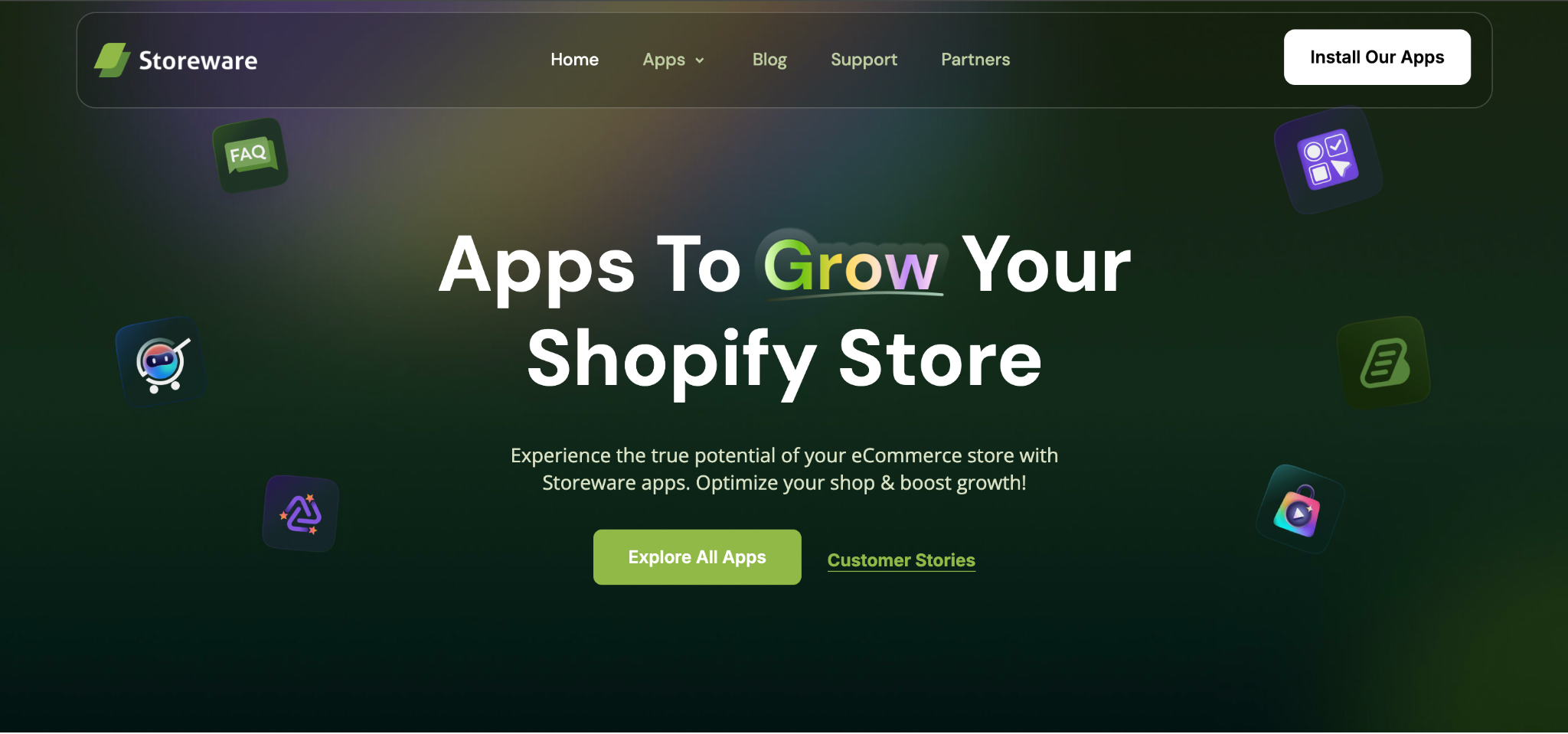
Portfolio Highlights: StoreSEO, TrustSync, StoreFAQ, BetterDocs for Shopify, EasyFlow, Vidify.
Rating: 4.8/5 Average Reviews.
Best For: Merchants wanting a multi-app Shopify growth company spanning SEO, reviews, support content, customization, and AI merchandising.
When discussing top Shopify app companies, it is important to frame Storeware correctly. It is a broader Shopify-focused app company building a connected portfolio of merchant tools across SEO, trust-building, documentation, FAQ management, product customization and AI-powered visual content. That distinction matters because Storeware is better understood as a portfolio operator than as a single-app vendor. In a Shopify ecosystem with over 17,000 apps, merchants increasingly value app companies that can solve related growth and CX problems from within one coherent ecosystem.
Storeware’s official site highlights a growing portfolio that includes
Each app targets a different merchant bottleneck. StoreSEO focuses on product, image, blog, and technical SEO.
TrustSync helps collect and surface reviews from platforms like Trustpilot, Google Reviews, and Etsy.
StoreFAQ gives merchants a structured FAQ layer to reduce buyer hesitation and support load.
BetterDocs for Shopify brings knowledge base functionality to the storefront.
EasyFlow helps merchants create customizable product options and variants.
Vidify adds AI-powered product video generation, aimed at stronger visual merchandising and engagement.
Taken together, this portfolio says something important about the company’s strategy: Storeware is building around merchant growth enablement, not around one isolated app category.
Shopify merchants are under pressure to improve visibility, create stronger trust signals, reduce support friction, differentiate products, and create more persuasive visual content. Those needs are not separate in practice. They overlap constantly in the real merchant workflow. A company that can support several of them from one ecosystem is often more strategically useful than one that does only one thing well. This is especially true for small and mid-sized merchants that want more coordination in their stack without buying a bloated all-in-one enterprise platform.
In that sense, Storeware mirrors a wider pattern in the Shopify ecosystem: the shift from isolated tools toward adjacent ecosystems. Merchants increasingly want fewer vendors, cleaner product relationships, and software that grows with their needs. Storeware is not trying to be everything to everyone, but it is clearly building a focused suite around merchant growth, customer education, product confidence, and engagement. That makes it one of the more interesting Shopify app companies to watch in 2026.
2. PageFly — Best for Custom Landing Pages and Conversion-Led Store Design
Founded / app launch: App launched September 28, 2017
Rating: 4.9/5 from 5,757 reviews.
Pricing: Free plan available; paid plans available via official pricing page.
Best For: Merchants that need custom pages, faster campaign execution, and stronger conversion architecture.
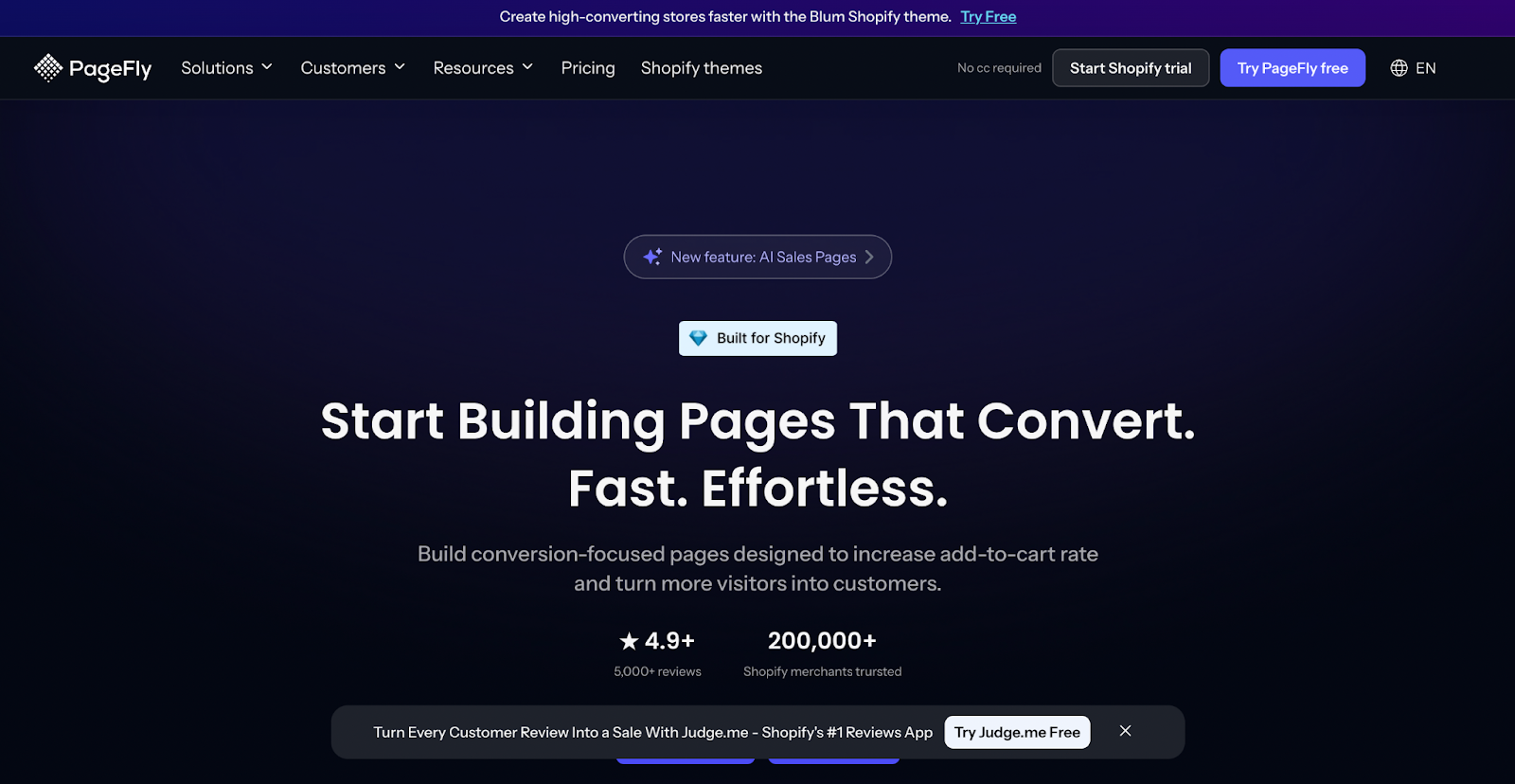
Few Shopify app companies have achieved the merchant mindshare that PageFly has in page building. The reason is simple: conversion-focused page design is one of the most persistent merchant needs on Shopify. Themes provide structure, but growth often requires more flexibility. Merchants want landing pages for offers, product storytelling pages, better collection layouts, custom homepage sections and more precise control over visual hierarchy.
PageFly solves that problem directly and at scale, which is why it continues to rank among the top Shopify apps in store design and CRO. Its Shopify App Store presence is especially strong: 4.9 stars from 5,757 reviews. That scale is important because it reflects years of real merchant adoption, not just short-term momentum.
PageFly’s own positioning has also matured. It no longer presents itself merely as a no-code page builder. It increasingly frames itself around conversion optimization, AI-assisted layout generation, A/B testing, and support for merchants ranging from founders to enterprise teams. That is a smart evolution, because in 2026, page building is not about aesthetics alone. It is about merchandising control and revenue efficiency.
3. TrackingMore — Best for Post-Purchase Tracking and Shipment Visibility
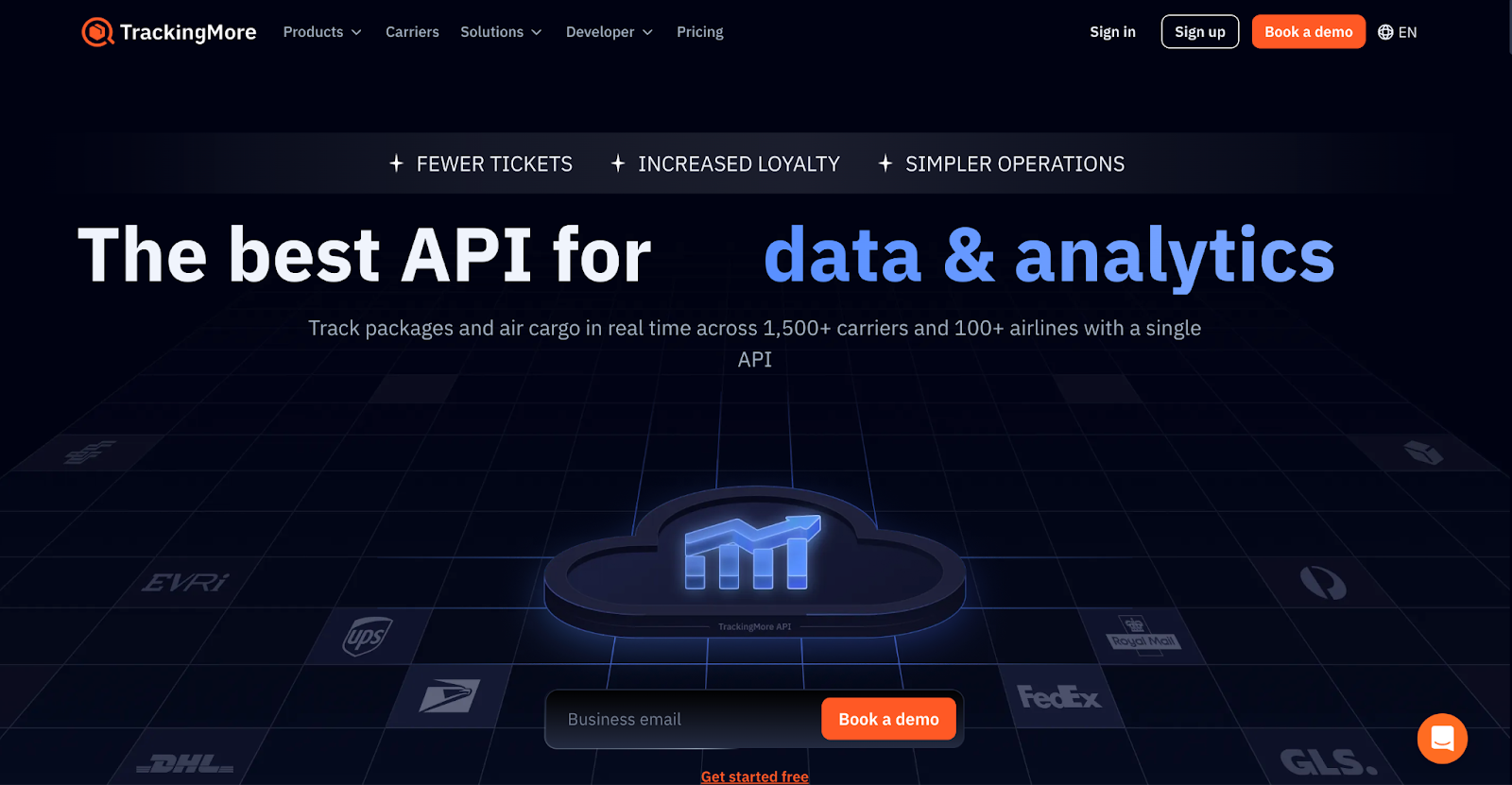
App launch: August 13, 2018.
Rating: 4.8/5 from 313 reviews.
Pricing: Free to install; paid plan starts at $9/month in the app listing snapshot.
Best For: Stores wanting better shipment communication, branded tracking, and reduced support pressure.
TrackingMore addresses one of the most underappreciated parts of eCommerce performance: the post-purchase experience. Many merchants spend heavily to acquire customers, then underinvest in what happens after checkout. But delivery transparency, shipment communication and branded order tracking are not minor operational details. They shape customer trust, reduce support burden, and influence whether a first-time buyer returns. TrackingMore’s value proposition is built around that reality.
On the Shopify App Store, TrackingMore holds a 4.8 rating from 313 reviews and emphasizes branded tracking, customization, real-time updates, and operational visibility. Its wider platform messaging goes further by highlighting API access, support for 1,500+ carriers, CSV imports, analytics, and tools to reduce WISMO queries. In other words, it is not merely a parcel-status plugin. It is a customer communication and logistics clarity layer.
Shopify’s growth is increasingly international and customer expectations around delivery communication are only getting sharper. Merchants operating across borders or across multiple fulfillment setups need more than the basic shipment visibility offered by carriers. They need a branded experience that reinforces confidence and reduces anxiety after the sale. TrackingMore helps turn a potentially stressful part of the customer journey into a trust-building one.
4. Rivyo — Best for Reviews, Loyalty, and Referral-Led Trust Building
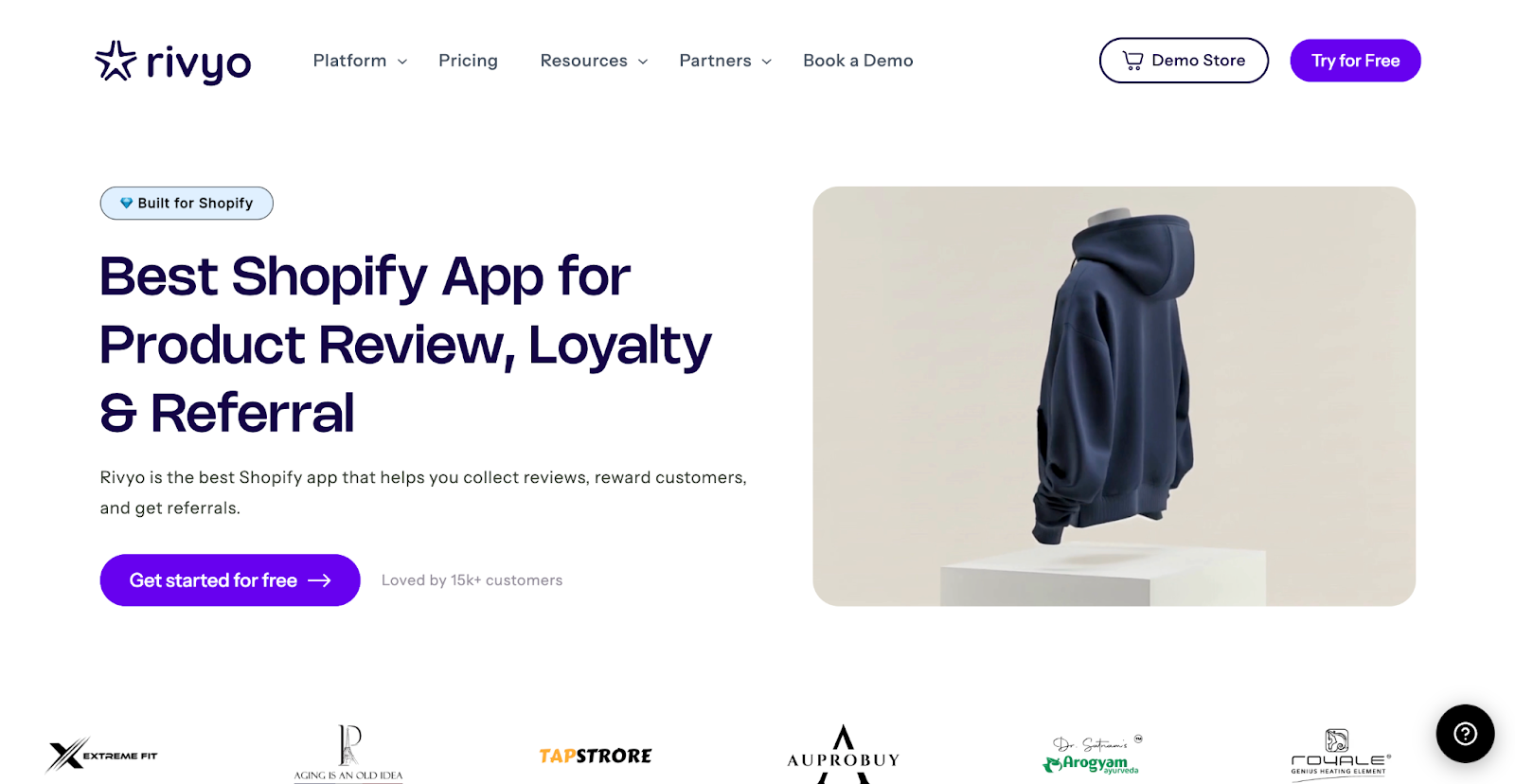
Founded: Not clearly stated in the reviewed official materials.
Rating: 4.9/5 from 890 reviews.
Pricing: Free to install; paid plans from $9/month.
Best For: Merchants wanting an affordable trust-and-retention stack combining reviews, loyalty, and referrals.
Rivyo is a strong example of a Shopify app company that understands merchant pain points in a combined rather than isolated form. Reviews, loyalty, and referrals are often treated as separate categories, but in practice, they all reinforce one core outcome: trust. Rivyo combines those layers into a single merchant-facing platform, which is why it remains one of the more compelling options for SMB and growth-stage stores that want more than a basic review widget.
Its Shopify App Store listing shows a 4.9 rating from 890 reviews and its product messaging highlights product reviews, social proof, loyalty, referral mechanics, photo/video reviews and compatibility with multiple Shopify setups. The point is not that Rivyo replaces every enterprise retention tool. The point is that it gives merchants a more unified trust stack than three disconnected lightweight apps would.
That proposition becomes more relevant in an app-saturated Shopify market. Merchants are increasingly wary of app sprawl. Every additional app adds cost, admin overhead, compatibility risk, and potential performance drag. A platform like Rivyo can be appealing because it bundles adjacent commercial functions into one cleaner unit. For smaller merchants, especially, that often creates better economics than stitching together separate providers.
5.UpPromote— Best for Affiliate And Referral Growth
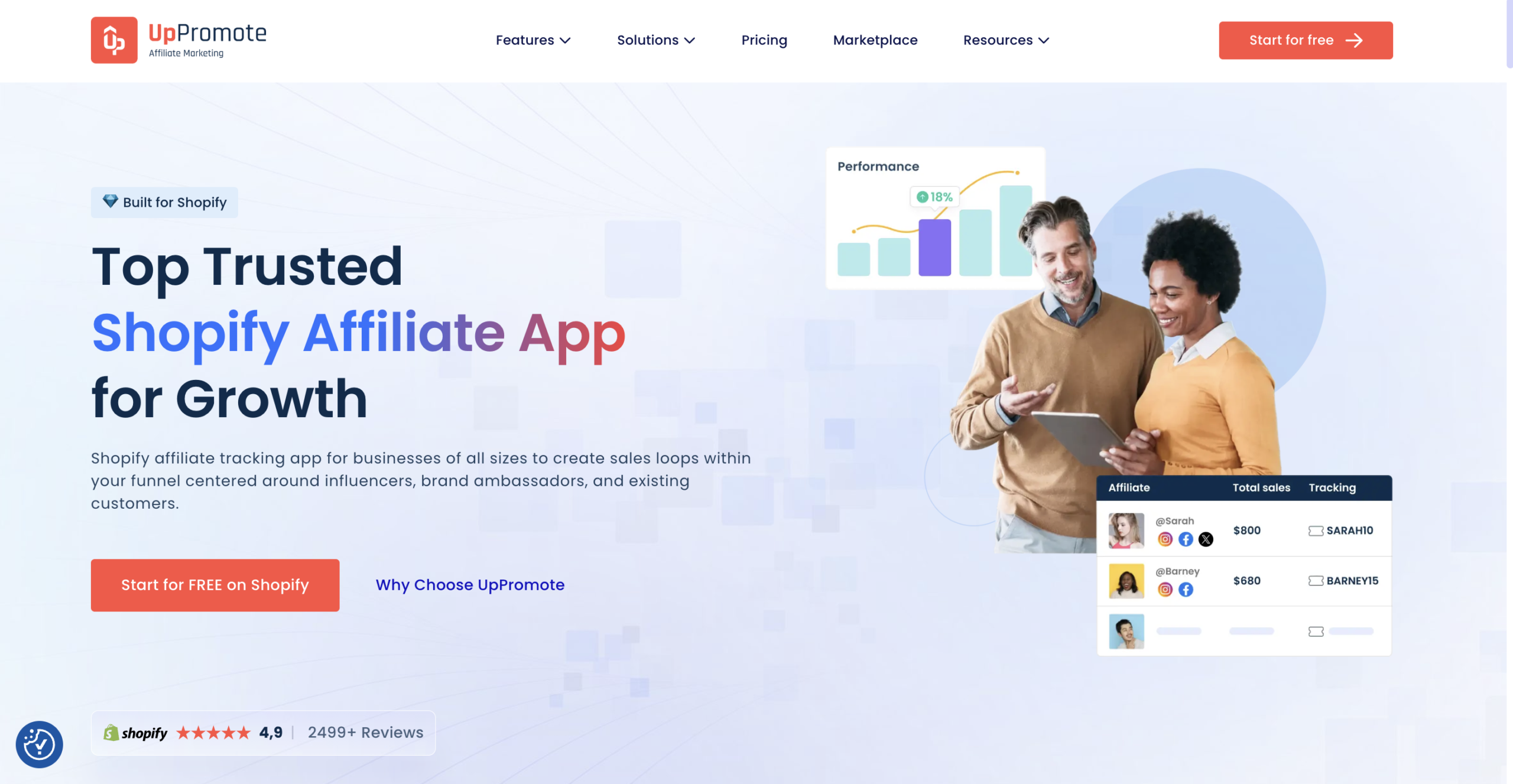
Rating: 4.9/5 from 3,254 reviews.
Pricing: Free to install with scalable paid tiers up to advanced and Plus-level needs.
Best For: Brands scaling through affiliate, ambassador, influencer, and referral-led customer acquisition.
As customer acquisition costs continue to pressure merchant margins, affiliate and referral channels are becoming more important. UpPromote has emerged as one of the clearest Shopify-native solutions in this space. Its product is designed to help merchants create affiliate programs, manage influencer and ambassador relationships, automate commission logic, reduce fraud and streamline payouts. That focus has earned it a substantial footprint in the ecosystem, including a 4.9 rating from 3,254 reviews.
That review depth matters. It suggests that UpPromote is not just appealing in theory; it is widely deployed by real merchants across different levels of complexity. Its broader site positioning is also well chosen. It presents the platform as accessible enough for brands with no affiliate experience, but robust enough for stores seeking structured, scalable partner-driven growth. That balance, ease of adoption without sacrificing operational control, is exactly what many merchants need.
6. FoxEcom / FoxKit — Best for AOV Optimization And Sales Boosting

Founded: 2021
Rating: 4.9/5 from 372 reviews
Pricing: Paid plans start from $19/month.
Best For: SMB merchants focused on AOV gains through merchandising and offer optimization.
FoxKit sits in one of the most commercially direct app categories on Shopify: average order value optimization. The app focuses on upsells, cross-sells, bundles, quantity discounts, in-cart offers, urgency mechanics, and related merchandising tools. On the Shopify App Store, it holds a 4.9 rating from 372 reviews and clearly positions itself around turning existing traffic into higher-value orders.
That simplicity is actually part of its strength. FoxKit is not trying to be a broad commerce operating system. It is solving a very clear merchant problem: how to make each buyer session worth more. For many merchants, especially those with stable traffic but margin pressure, that can be more valuable than chasing additional traffic. FoxEcom’s own site sharpens the pitch further by explicitly targeting growing SMBs looking for an affordable but meaningful impact.
This category is especially relevant in a mature Shopify market. When competition intensifies, merchants often find that the easiest growth is not more visitors, but better monetization of the visitors they already have. Upsells, related offers, bundles, and urgency devices are tried-and-tested tools for doing that. FoxKit’s appeal lies in making those tools more accessible without requiring a more expensive merchandising stack.
FoxKit, therefore, earns its place among the top Shopify apps not because it tries to do everything, but because it remains tightly aligned with one of the most universal eCommerce goals: raising order value without raising acquisition cost.
7. AiTrillion — Best for an All-in-One Retention Marketing Stack
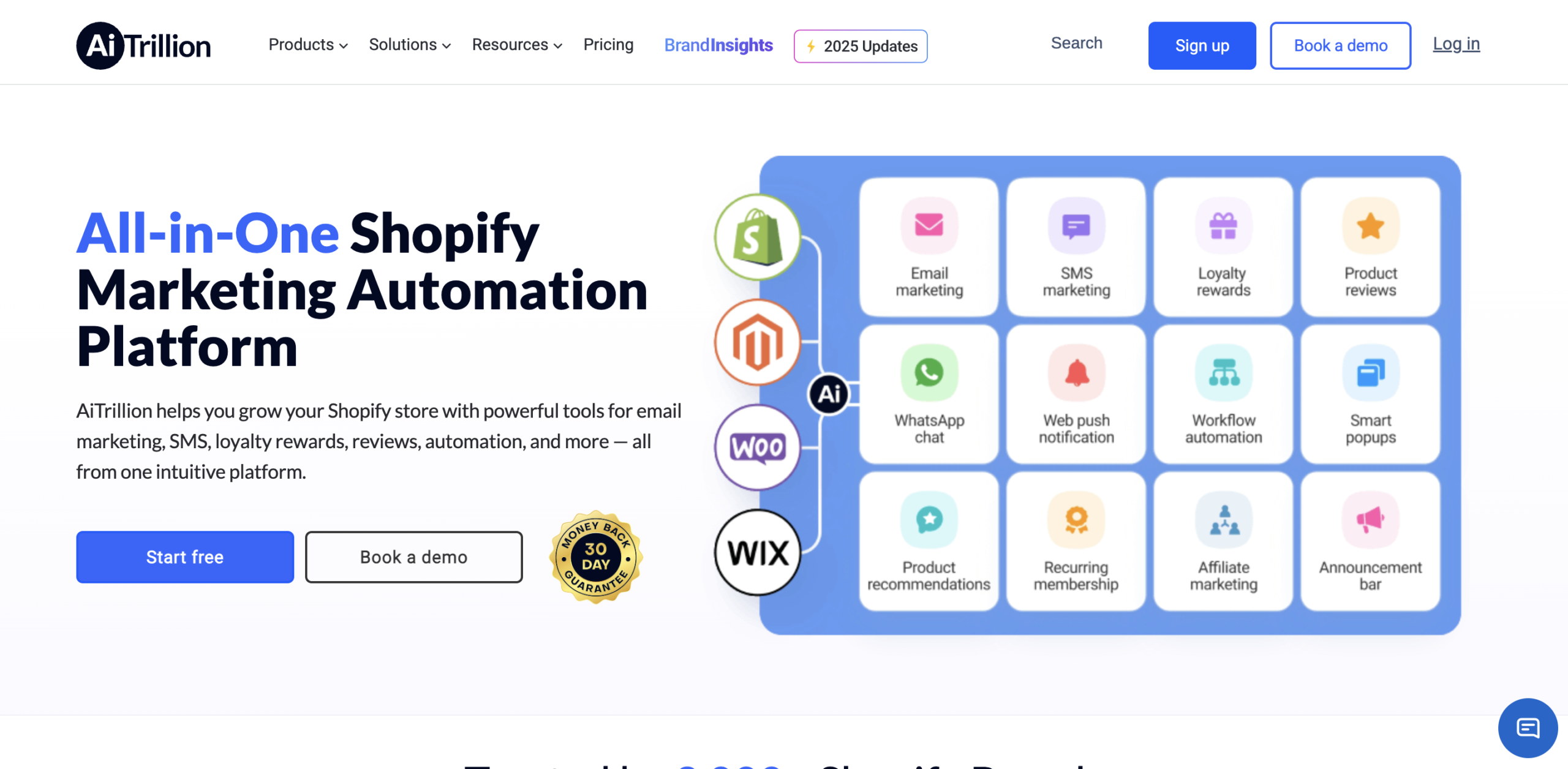
Rating: 4.8/5 from 254 reviews.
Pricing: Free plan and free trial available; broader pricing available via the official site.
Best For: Stores wanting a unified retention layer across loyalty, reviews, email, SMS, and automation.
AiTrillion is one of the clearest examples of the “suite” model inside the Shopify ecosystem. Instead of solving a single narrow use case, it brings together loyalty rewards, reviews, email, SMS, web push, memberships, affiliate tools, and workflow automation. On the Shopify App Store, it holds a 4.8 rating from 254 reviews, and its official site positions it as a broad customer-journey platform used by thousands of Shopify brands.
Its business appeal is obvious. Merchants increasingly want to reduce stack complexity, especially across the retention layer. Running separate systems for loyalty, messaging, reviews, and automation can get expensive and messy. AiTrillion’s promise is that merchants can consolidate more of that functionality into one connected environment. That is especially attractive for scaling brands that have outgrown starter apps but are not ready for heavy enterprise tooling.
The company also benefits from a larger market shift. Shopify in 2026 is not only about acquisition; it is about maximizing lifetime value. The report’s emphasis on efficiency, merchant profitability, and ecosystem maturity reinforces that. In that context, a company like AiTrillion becomes strategically interesting because it supports customer retention as a system, not as one-off campaigns.
8. Consentik — Best for GDPR and Privacy Compliance
Founded: 2018
Rating: 4.9/5 from 264 reviews.
Pricing: Free + paid tiers
Best For: International Shopify stores that need practical privacy and cookie compliance.
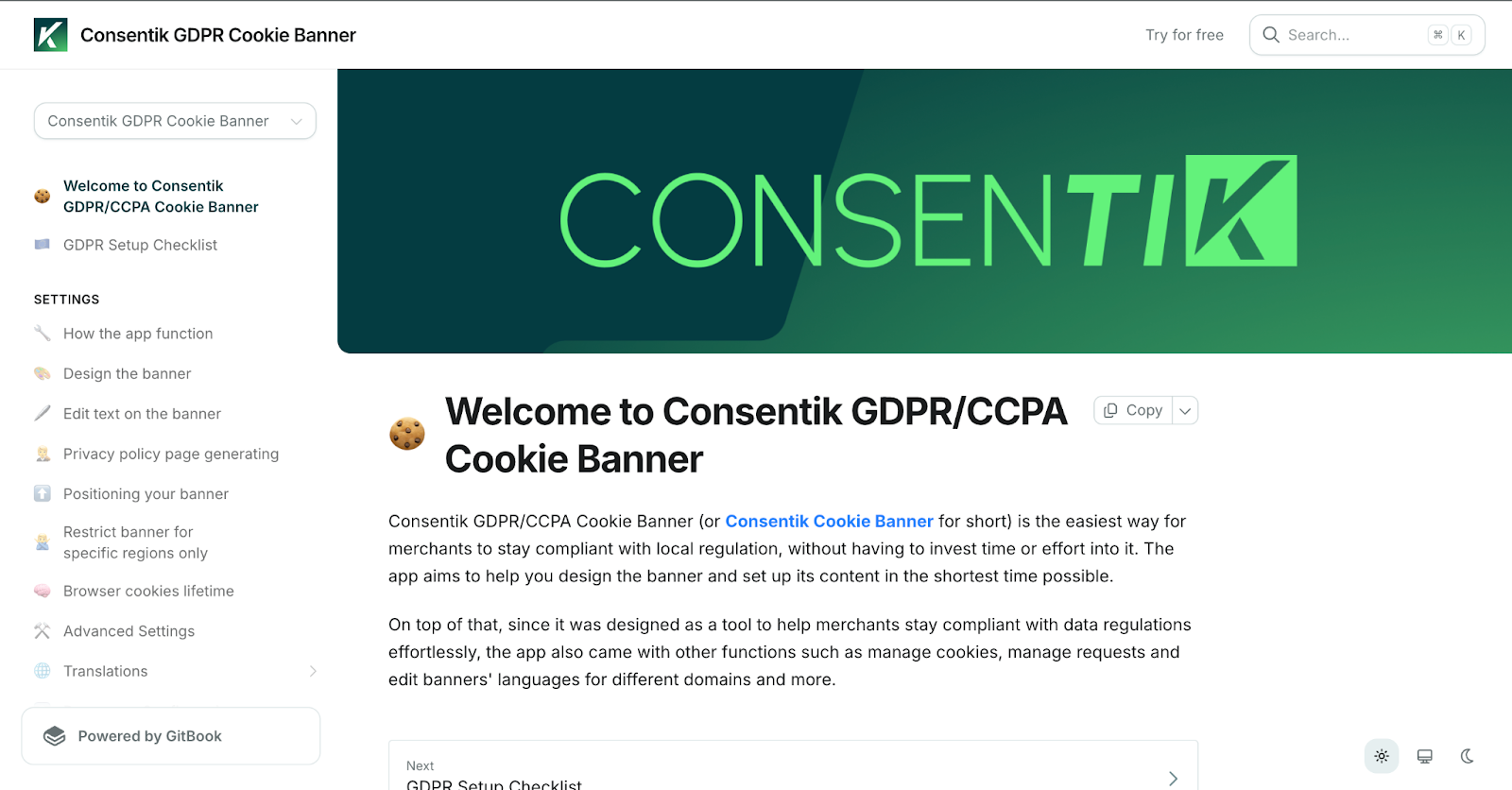
Consentik operates in a category that many merchants only appreciate once they need it urgently: compliance. Its app is designed around GDPR/CCPA cookie and privacy management, multilingual consent support, and integrations like Google Consent Mode V2. It has earned a 4.9 rating from 264 reviews, which is significant in a category where merchants usually care about trust, reliability, and ease of implementation more than feature novelty.
Why is this category becoming more important in 2026? Because Shopify is more global. The report highlights stronger international expansion and faster non-North American growth, which means more merchants are operating across markets with more complex privacy expectations. Cookie consent is no longer just a European headache. It is a normal part of running a serious digital commerce brand.
Consentik’s own documentation references four plan tiers
- FREE
- PLUS
- ADVANCED and
- UNLIMITED
which suggests the company understands the merchant ladder from basic implementation to more advanced consent management and analytics. That tiering is useful because compliance needs tend to grow with market complexity. Smaller brands want minimal friction. Larger brands want more controls, reporting, and consistency across storefront behaviors.
Among top Shopify app companies, Consentik stands out less because it is flashy and more because it represents a category of software that increasingly becomes foundational as stores grow internationally. Compliance may not be what drives the first sale, but it often determines whether growth can happen smoothly at scale.
9. ToastiBar — Best for Social Proof, Urgency, and Tactical Conversion Uplift
Founded: 2017
Rating: 4.9/5 from 547 reviews.
Pricing: Free plan available; paid plans start from $9.99/month
Best For: Stores wanting quick conversion wins through social proof, urgency, and behavioral notifications.
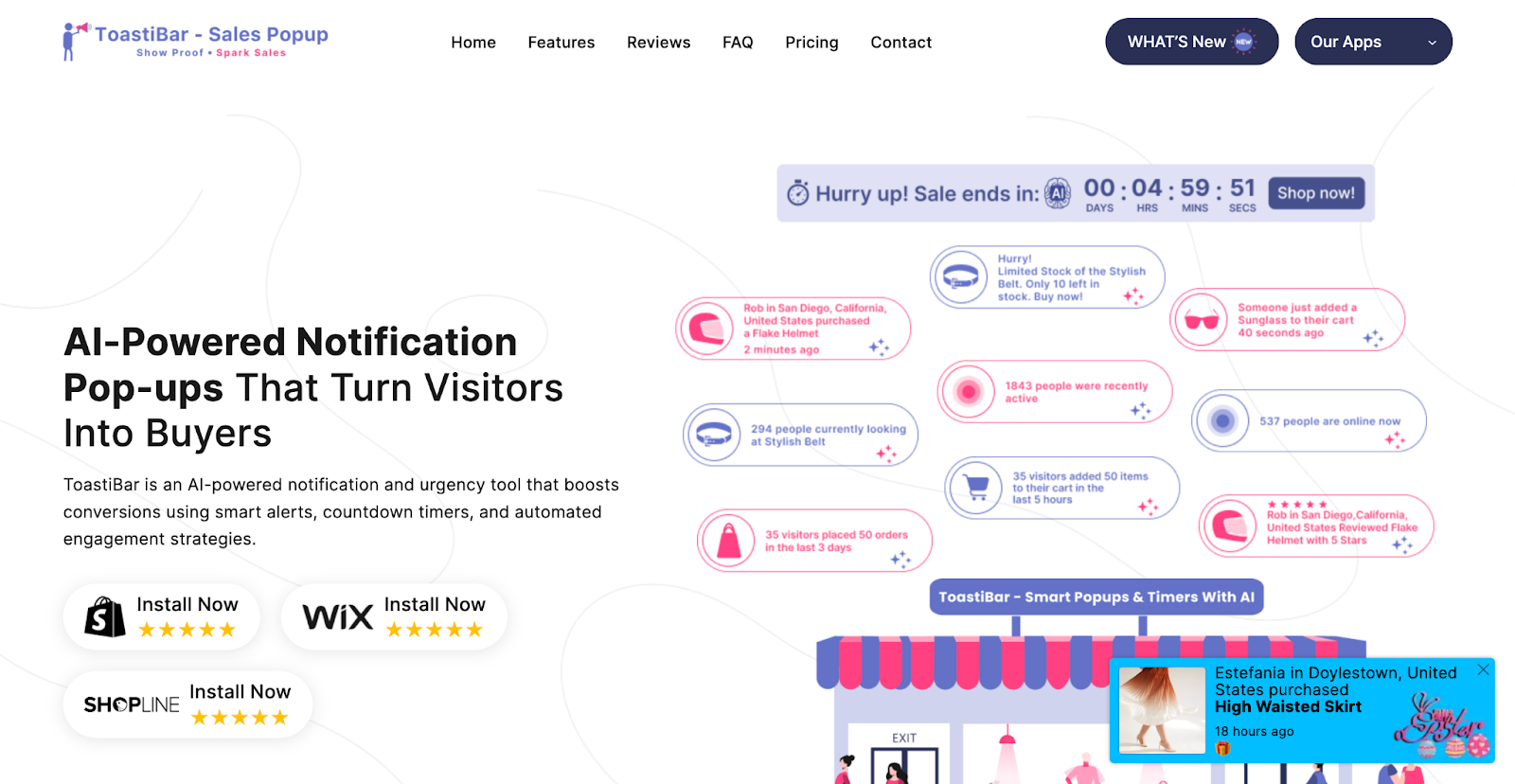
ToastiBar belongs to a category that looks simple but can be commercially powerful when executed well: urgency and social proof. Its app combines sales popups, visitor notifications, countdown timers, low-stock alerts, and AI-assisted setup and copy generation. On the Shopify App Store, it carries a 4.9 rating from 547 reviews, suggesting a strong product-market fit among merchants that want fast, visible conversion improvements.
What makes ToastiBar more interesting than a generic pop-up app is its attempt to modernize the category. The product does not just show notifications. It frames itself around AI-guided setup, copy optimization, analytics, A/B testing, and localization. That reflects a wider Shopify expectation in 2026: merchants want easy-to-use tools, but they also want help making them perform better.
In the broader ecosystem, ToastiBar represents a larger truth: not every valuable Shopify app needs to be a platform. Some of the best tools are simply the ones that provide fast, repeatable wins in a clear part of the funnel.
10. Transtore — Best for Localization And Global Expansion
Founded: 2022
Rating: 4.6/5 from 770 reviews
Pricing: Free plan available; advanced localization tiers available
Best For: Merchants expanding into multilingual, multicurrency, cross-border selling.
If one category is structurally positioned to grow with Shopify, it is localization. The ecosystem report makes clear that international growth is outpacing domestic growth in several segments. As more merchants expand globally, stores need better multilingual content, smoother currency conversion, geolocation-aware experiences, and stronger multilingual SEO. Transtore is built for exactly that environment.
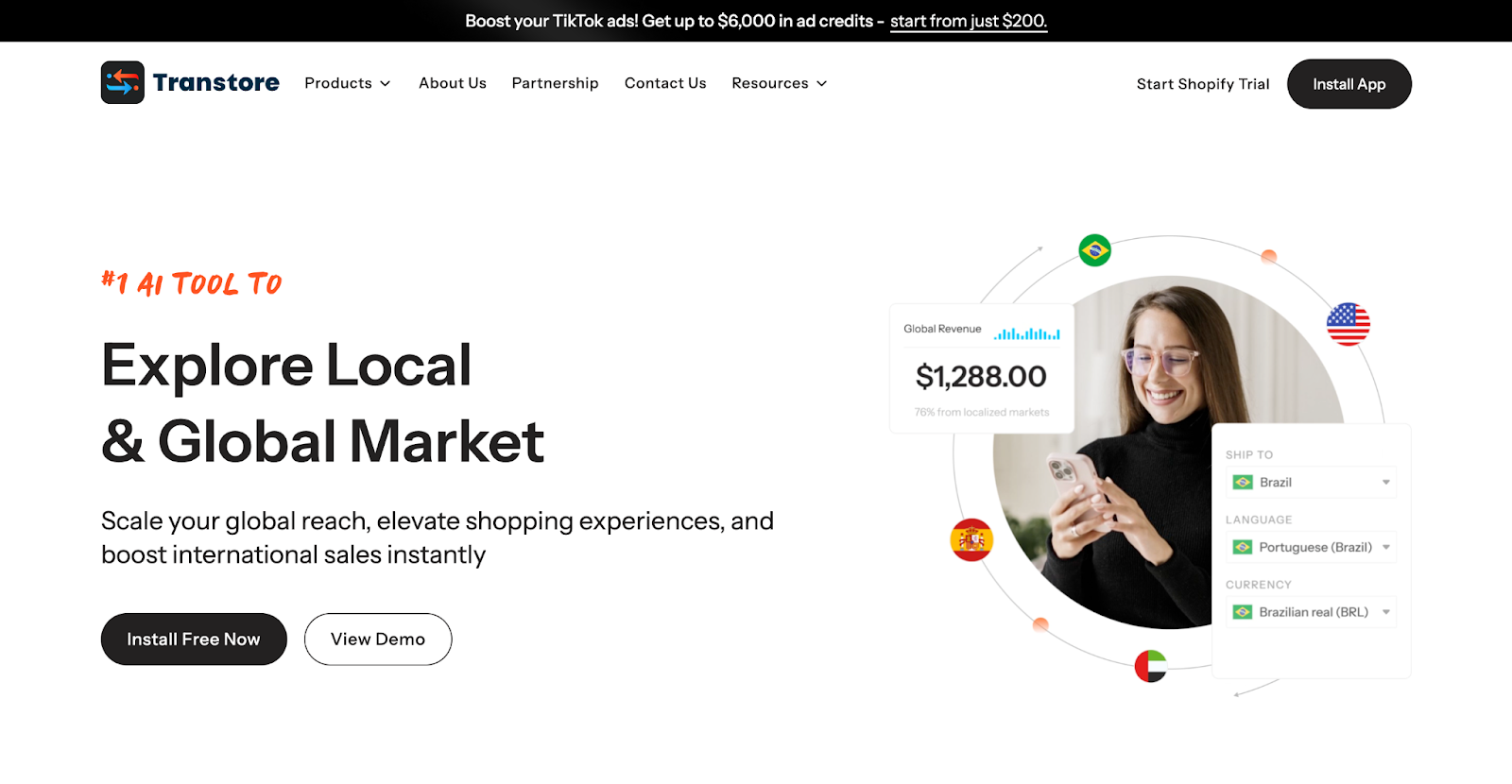
Its Shopify App Store presence shows a 4.6 rating from 770 reviews, and its positioning centers on language translation, currency conversion, geolocation-based redirection, GPT-assisted translation, glossary control and multilingual SEO. The company’s site reinforces that vision, presenting the platform as a way for merchants to adapt stores for global audiences rather than merely translating text strings.
That distinction matters. Real international selling is not just about language. It is about reducing friction and increasing confidence for customers in different markets. Currency display, familiar browsing flows, region-aware content, and translated metadata all contribute to that. Transtore’s broader positioning suggests it understands localization as a conversion function, not just a backend feature.
This gives Transtore strong relevance among Shopify app companies in 2026. As global commerce becomes more normal for Shopify merchants, localization tooling will shift from an optional growth enhancer to a baseline market-entry infrastructure. Merchants that localize well will likely outperform those that simply expose the same storefront to every region and hope for the best.
11. Judge.me — Best for Product Reviews And Scalable Social Proof
Rating: 5.0/5 from 38,682+ reviews on the Shopify App Store
Pricing: Free plan available; paid plan at $15/month
Best For: Merchants wanting strong on-site reviews, rich social proof, SEO value, and predictable pricing from a category leader
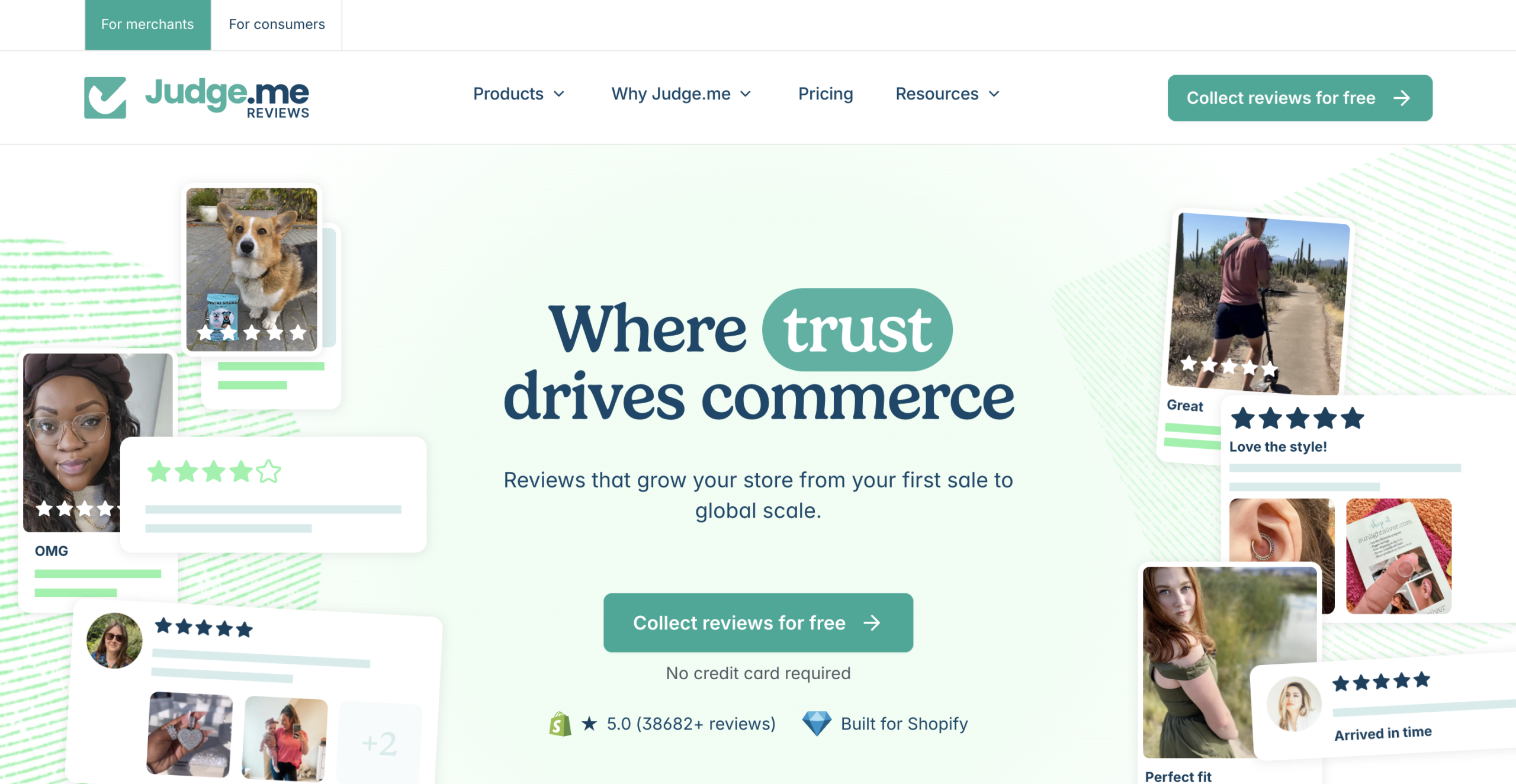
If there is one company that has become almost synonymous with Shopify product reviews, it is Judge.me. In an eCommerce environment where trust directly affects conversion, Judge.me has built one of the strongest review-led ecosystems on the platform. Its Shopify App Store listing shows a 5.0 rating from 37,360 reviews, making it one of the most reviewed and most socially validated Shopify apps in the market. The app’s merchant-facing value proposition centers on unlimited product reviews, photo and video reviews, automated review requests, customizable widgets, review imports, and SEO-enhancing rich snippets.
What makes Judge.me especially important in 2026 is that it has moved beyond being a simple review widget. Its official site frames the company around the idea that “trust drives commerce,” and the scale signals are substantial. Judge.me says it serves 500,000 stores, has collected 35 million verified reviews, generated 29 million discount codes, and supported $87 billion in total sales from Judge.me stores in 2025. Those numbers make it one of the clearest examples of a Shopify app company that has become true category infrastructure rather than just a useful app.
12. Reputon — Best for Third-Party Review Reputation and Multi-Platform Trust Management

Portfolio Scale: 12 apps listed on the Shopify App Store partner profile. Source
Representative Ratings: Google Reviews by Reputon — 4.9/5 from 1,237 reviews; Reputon Customer Reviews App — 4.9/5 from 1,002 reviews.
Unlike single-app companies, Reputon is better understood as a reputation-focused Shopify portfolio operator. Its core value proposition is not limited to one review widget or one ratings tool. Instead, Reputon has built an ecosystem of Shopify apps designed to help merchants collect, display, import, and syndicate reviews from external platforms such as Google, Trustpilot, Facebook, Amazon, Etsy, and eBay. Its official website describes the company as a “one-stop shop” for online reputation, built around consolidating, improving, and displaying feedback from third-party review platforms directly on Shopify stores. Source
Its Shopify partner profile reinforces that broader positioning. Reputon currently lists 12 apps on the Shopify App Store. These include products such as Google Reviews by Reputon, Reputon Customer Reviews App, Reputon Testimonials Slider, Reputon Etsy Reviews, Reputon eBay Reviews, and other reputation-oriented tools. Several of these apps have strong merchant traction. For example, Google Reviews by Reputon shows 4.9 stars from 1,237 reviews, while Reputon Customer Reviews App shows 4.9 stars from 1,002 reviews. This breadth makes Reputon one of the more distinctive trust-oriented Shopify app companies in the ecosystem.
Supporting Comparison Tables
Ownership & Independence Matrix
Because many Shopify app companies do not foreground corporate history on their public pages, the best practical merchant lens is whether they appear to operate as focused independent brands or broader portfolio/suite providers.
| Company | Operating Model | Public Positioning in Reviewed Sources | Merchant Implication |
| Storeware | Portfolio company | Multi-app Shopify growth ecosystem | Good for merchants wanting adjacent tools from one provider |
| PageFly | Category specialist | Dedicated page-building leader | Best-of-breed page-building focus |
| TrackingMore | Category specialist | Tracking and logistics visibility platform | Strong operational specialization |
| Rivyo | Focused bundled product | Reviews + loyalty + referral system | Efficient trust stack for SMBs |
| UpPromote | Category specialist | Affiliate/referral growth platform | Strong channel-specific expertise |
| FoxEcom / FoxKit | Focused conversion tool | AOV and sales-boost stack | Tactical monetization-focused fit |
| AiTrillion | Suite platform | Broader retention and messaging system | Useful for reducing retention stack fragmentation |
| Consentik | Category specialist | Compliance and cookie management | Niche but increasingly essential |
| ToastiBar | Conversion specialist | Popups, urgency, social proof toolkit | Fast tactical CRO layer |
| Transtore | Internationalization specialist | Localization and cross-border growth platform | Strong for global expansion readiness |
| Judge.me | Category specialist | Product reviews and trust platform | Strong best-of-breed option for on-site reviews and social proof |
| Reputon | Portfolio company | Multi-app reputation management ecosystem | Strong fit for merchants wanting external review and testimonial syndication |
This matrix matters because the right app-company model depends on the merchant. Some merchants want best-of-breed tools in each category. Others want fewer vendors and more adjacent product fit. Shopify’s maturity means both models can work—but only when chosen intentionally.
Specialization Matrix
| Category | Primary Companies | Secondary Overlap |
| SEO & discoverability | Storeware / StoreSEO | Transtore |
| Store design & CRO | PageFly | ToastiBar, FoxKit |
| Product reviews & on-site social proof | Judge.me, Rivyo | Storeware / TrustSync |
| Third-party reputation & external review syndication | Reputon | Storeware / TrustSync, Judge.me |
| Documentation & self-service | Storeware / BetterDocs, StoreFAQ | AiTrillion |
| Product customization | Storeware / EasyFlow | PageFly |
| AI visual merchandising | Storeware / Vidify | PageFly |
| Post-purchase operations | TrackingMore | AiTrillion |
| Affiliate / referral growth | UpPromote | Rivyo, AiTrillion |
| AOV optimization | FoxKit | ToastiBar, PageFly |
| Retention automation | AiTrillion | Rivyo, UpPromote |
| Compliance | Consentik | Transtore |
This table shows how much category overlap now exists in the ecosystem. The strongest app companies are no longer confined to one rigid box. Many are expanding into adjacent pain points where the commercial logic overlaps. That makes company-level analysis more useful than app-level analysis alone.
Strategic Challenges And Opportunities
The Shopify app market in 2026 offers enormous upside, but it is much less forgiving than it was in earlier years. The biggest opportunity is obvious: the platform itself is bigger, richer, and more structurally embedded in global commerce than ever. More merchants, more transactions, more regions, and more buyer touchpoints create more room for specialized app companies to solve valuable problems. That is why the ecosystem continues to produce strong category leaders.
Challenge #1: Bringing Visibility in the Marketplace
The first major challenge is saturation. With more than 17,000 apps in the ecosystem, visibility is difficult and merchant patience is lower. Apps that once might have found traction with a narrow feature now have to compete on UX quality, support responsiveness, performance discipline, app-store trust signals, and long-term roadmap credibility. In a crowded market, merchants are more likely to choose companies that feel stable and category-defining.
Challenge #2: Overall App Performance
A second challenge is performance. The report makes clear that faster storefront architecture is becoming more important, especially as headless practices influence merchant expectations more broadly. That raises pressure on all app companies. They cannot simply layer scripts onto a storefront and assume merchants will tolerate the tradeoff. Top Shopify app companies increasingly need to think like infrastructure providers, clean integration, lower friction and less performance drag.
Challenge #3: Suite Over Stack
A third challenge is stack fragmentation. Merchants are tired of solving one problem by creating three new ones. Every app means more onboarding, more settings, more billing, more support dependency and more risk of UX inconsistency. This is why portfolio companies and suite models are gaining relevance. Storeware’s broader app ecosystem, Rivyo’s bundled trust stack, and AiTrillion’s retention suite all reflect the same market demand: merchants want more adjacent value per vendor.
Challenge #4: Native AI Reduces the Value
For Shopify app companies, Sidekick creates a serious competitive challenge because it raises the possibility that merchants will rely more on Shopify’s native AI layer for tasks that previously required standalone apps. If Sidekick can recommend optimizations, generate custom workflows, build lightweight custom apps, help edit themes, surface analytics and guide merchants toward app choices inside the admin, then many low-complexity “helper apps” may find it harder to justify their place in a merchant’s stack. This is especially relevant in an ecosystem where merchants are already becoming more selective, where the Built for Shopify standard is gaining importance and where app sprawl is increasingly seen as technical debt rather than flexibility.
But those same challenges create the biggest opportunities. What are those? Let us have a look here.
Opportunity #1: Improve Discoverability
Companies that reduce complexity, improve discoverability, support cross-border selling, or tie directly to measurable commercial lift can still grow strongly. AI is a major example. As commerce discovery moves toward answer engines, recommendation systems, and machine-readable storefronts, apps that help stores become more structured, more multilingual, and more searchable will become more valuable. That gives upside to SEO and localization-focused companies, especially those that treat content quality as part of commercial infrastructure rather than as a marketing accessory.
Opportunity #2: Customer Efficiency Gains
Another major opportunity is customer efficiency. The Shopify market is increasingly emphasizing profit quality, not just revenue growth. Merchants care more about repeat purchase behavior, AOV, lower support burden, and better conversion from existing traffic. That environment favors app companies such as Rivyo, FoxKit, TrackingMore, ToastiBar, and AiTrillion, all of which sit close to margin-sensitive merchant goals.
Opportunity #3: Global Expansion
Internationalization is perhaps the clearest growth frontier. The report points out that international revenue growth is outpacing North America. As that continues, localization, compliance, translation, currency switching, multilingual SEO, and region-sensitive UX will become more standard across the merchant stack. App companies that solve those needs cleanly are positioned well for the next phase of Shopify commerce.
Ultimately, the top Shopify app companies in 2026 are not just feature-rich businesses. They are businesses aligned with the real structural shifts in commerce: AI-assisted discovery, revenue efficiency, global expansion, cleaner integration, and stronger merchant trust. That is what makes them resilient.
Opportunity #4: High-Value App Innovation
Sidekick creates one of the biggest opportunities in the Shopify market for sophisticated app companies. The companies most likely to benefit are not the ones selling narrow, replaceable utilities, but those building high-value products that complement Shopify’s AI layer rather than compete with it directly. The Shopify ecosystem report frames this as part of the shift toward agentic commerce, where AI systems increasingly help merchants identify friction, automate execution, and improve business efficiency. In that environment, app companies can win by building deeper category tools, AI-enhanced workflows, better structured data layers, performance-conscious integrations, and products that generate clear ROI beyond what a native assistant can do alone.
Methodology
To make this industry analysis useful for merchants and decision-makers, the research was structured around a company-first evaluation model rather than a simple app roundup. The goal was not just to identify popular Shopify apps, but to assess which Shopify app companies are most relevant in the current market based on ecosystem fit, merchant adoption, strategic category relevance, and product positioning.
Data Sources
This analysis was built using a combination of primary and secondary research sources. The core market context came from the attached Shopify ecosystem report, which provided the macro-industry baseline for 2026, including platform revenue, GMV, live store count, app-store size, B2B growth, Shopify Plus expansion, AI commerce trends and performance shifts such as the rise of headless storefronts.
At the company level, the review relied primarily on official sources, including Shopify App Store listings and the official websites of each company covered in the article. These sources were used to evaluate positioning, app scope, merchant-facing messaging, pricing structure, review volume, ratings, and category focus. Representative company sources included Storeware, PageFly, TrackingMore, Rivyo, UpPromote, FoxEcom / FoxKit, AiTrillion, Consentik, ToastiBar, and Transtore. App-store ratings and pricing references were cross-checked using official Shopify listings wherever available.
Company Selection Criteria
The companies included in this analysis were selected based on a mix of market visibility, category relevance, and strategic importance within the Shopify ecosystem. Priority was given to companies operating in high-impact merchant categories such as SEO, page building, post-purchase operations, social proof, loyalty, affiliate growth, conversion optimization, compliance, and localization. These categories were chosen because they map most directly to Shopify’s current growth drivers: discoverability, conversion efficiency, retention, international expansion, and operational maturity. This list includes both independent category leaders and portfolio-based companies, including Storeware, which is evaluated based on its multi-app ecosystem approach.
Evaluation Metrics
Each company was assessed across a consistent set of commercial and ecosystem-oriented metrics. These included:
- Category importance: how relevant the company’s core category is to Shopify merchants in 2026
- Merchant adoption signals: app-store review count, rating strength, and product maturity
- Strategic fit: alignment with major Shopify trends such as AI discovery, retention, B2B growth, international selling, and storefront performance
- Product breadth vs. specialization: whether the company succeeds as a focused category leader or as a broader multi-app / suite operator
- Pricing accessibility: whether the product appears viable for SMB merchants, scaling brands, or both
- Operational relevance: how closely the app maps to measurable merchant outcomes such as traffic growth, conversion lift, AOV improvement, lower support load, stronger customer retention, or easier global expansion
This framework was designed to avoid ranking companies purely by popularity. A high-volume app with weak strategic fit was considered less compelling than a strong category player solving a more durable merchant problem.
Verification Process
To improve accuracy, the analysis prioritized official company materials over third-party listicles or promotional claims. App positioning, ratings, pricing and merchant-facing features were checked against official Shopify App Store listings whenever possible. Company websites were then used to verify broader portfolio positioning, use-case framing and product ecosystem breadth. This was especially important for companies like Storeware, where the broader company narrative could not be captured by a single app listing alone.
Where exact founding dates or corporate background details were not clearly available on official sources, the analysis avoided overclaiming and treated those details conservatively. This approach was used to keep the article grounded in verifiable information rather than assumptions.
Limitations
Like most ecosystem analyses, this study has a few practical limitations. First, app-store ratings and review counts are snapshots and may change over time as companies release updates, enter new markets, or scale merchant acquisition. Second, public app listings do not always reflect deeper product quality, retention rates, customer satisfaction over time, or internal merchant ROI. Third, some companies do not publicly disclose founding dates, ownership structure, or product roadmap details, which limits the level of historical comparison possible from official sources alone.
The Future of Shopify App Companies Starts Here
The Shopify ecosystem of 2026 is far more sophisticated than the app economy many merchants first encountered years ago. Today, Shopify apps sit at the center of how stores grow, convert, localize, build trust, and retain customers. That means the companies behind those apps deserve far more attention than they used to receive. Merchants are no longer just choosing tools. They are choosing operating partners inside one of the world’s largest digital commerce ecosystems.
For merchants evaluating top Shopify app companies, the final takeaway is simple: choose leverage over novelty. The best app stack is not the one with the most logos in your admin. It is the one that improves the actual economics of your business. In 2026, that means discoverability, conversion rate, trust, retention, compliance, international readiness, and operational clarity. The companies in this article matter because each one helps solve one or more of those problems in a market where the cost of getting them wrong is getting higher.
This comprehensive industry analysis was prepared by the Startise research team. For more in-depth WordPress ecosystem insights, subscribe to our blog.